Ramon Roche
3d457528d2
Ramon Roche
3d457528d2
The clang-tidy CI target builds against the SITL (px4_sitl_default-clang)
compilation database. Three libraries in src/lib/drivers/ were
unconditionally added via add_subdirectory(), causing them to appear in
compile_commands.json despite requiring NuttX-only headers:

- mcp_common: includes px4_platform/gpio/mcp.hpp (NuttX platform GPIO)
- smbus: extends device::I2C which resolves to the NuttX I2C driver
- smbus_sbs: includes smbus/SMBus.hpp, same I2C dependency chain

When clang-tidy analyzed these files it failed on clang-diagnostic-error
(fatal: header not found) since the platform headers don't exist in SITL.

The previous commit worked around this by adding the paths to
CLANG_TIDY_EXCLUDE_EXTRA in the Makefile, but the proper fix is to prevent
these libraries from entering the compilation database at all.

Gate mcp_common, smbus, and smbus_sbs behind
if(PX4_PLATFORM STREQUAL "nuttx") in src/lib/drivers/CMakeLists.txt.
This follows the established pattern already used by the device/ library
in the same directory, which conditionally includes NuttX-specific sources
(CDev.cpp, I2C.cpp, SPI.cpp) while compiling posix stubs for SITL.

The other libraries in the directory (accelerometer, gyroscope, led,
magnetometer, rangefinder) are pure abstractions over uORB topics and
internal utilities with no platform-specific hardware dependencies, so
they compile fine on all platforms without any gating.

Remove the now-unnecessary mcp_common and smbus paths from
CLANG_TIDY_EXCLUDE_EXTRA, keeping only the emscripten failsafe exclusion
(requires the emscripten SDK, not a platform build issue).

Signed-off-by: Ramon Roche <mrpollo@gmail.com>

The autopilot stack the industry builds on.




About
PX4 is an open-source autopilot stack for drones and unmanned vehicles. It supports multirotors, fixed-wing, VTOL, rovers, and many more experimental platforms from racing quads to industrial survey aircraft. It runs on NuttX, Linux, and macOS. Licensed under BSD 3-Clause.
Why PX4
Modular architecture. PX4 is built around uORB, a DDS-compatible publish/subscribe middleware. Modules are fully parallelized and thread safe. You can build custom configurations and trim what you don't need.
Wide hardware support. PX4 runs on a wide range of autopilot boards and supports an extensive set of sensors, telemetry radios, and actuators through the Pixhawk ecosystem.
Developer friendly. First-class support for MAVLink and DDS / ROS 2 integration. Comprehensive SITL simulation, hardware-in-the-loop testing, and log analysis tools. An active developer community on Discord and the weekly dev call.
Vendor neutral governance. PX4 is hosted under the Dronecode Foundation, part of the Linux Foundation. Business-friendly BSD-3 license. No single vendor controls the roadmap.
Supported Vehicles
 Multicopter |
 Fixed Wing |
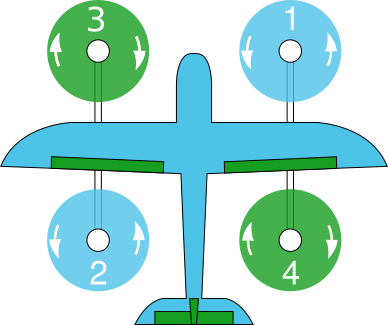 VTOL |
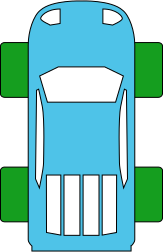 Rover |
…and many more: helicopters, autogyros, airships, submarines, boats, and other experimental platforms. These frames have basic support but are not part of the regular flight-test program. See the full airframe reference.
Quick Start
git clone https://github.com/PX4/PX4-Autopilot.git --recursive
cd PX4-Autopilot
make px4_sitl
Note
See the Development Guide for toolchain setup and build options.
Documentation & Resources
| Resource | Description |
|---|---|
| User Guide | Build, configure, and fly with PX4 |
| Developer Guide | Modify the flight stack, add peripherals, port to new hardware |
| Airframe Reference | Full list of supported frames |
| Autopilot Hardware | Compatible flight controllers |
| Release Notes | What's new in each release |
| Contribution Guide | How to contribute to PX4 |
Community
- Weekly Dev Call — open to all developers (Dronecode calendar)
- Discord — Join the Dronecode server
- Discussion Forum — PX4 Discuss
- Maintainers — see
MAINTAINERS.md - Contributor Stats — LFX Insights
Contributing
We welcome contributions of all kinds — bug reports, documentation, new features, and code reviews. Please read the Contribution Guide to get started.
Governance
The PX4 Autopilot project is hosted by the Dronecode Foundation, a Linux Foundation Collaborative Project. Dronecode holds all PX4 trademarks and serves as the project's legal guardian, ensuring vendor-neutral stewardship — no single company owns the name or controls the roadmap. The source code is licensed under the BSD 3-Clause license, so you are free to use, modify, and distribute it in your own projects.